
Introduction
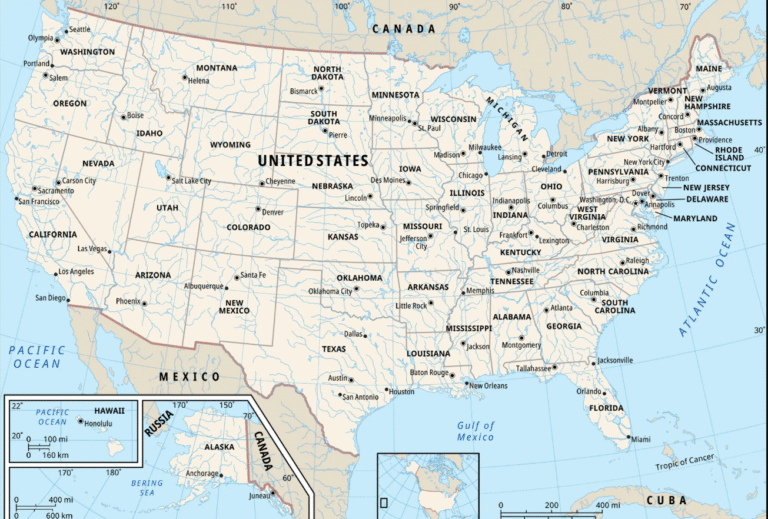
The map of the United States is one of the most widely studied and recognized geographic representations in the world. It helps people understand the country’s 50 states, major cities, regions, and natural features. Whether used in education, travel planning, or business research, the map of the United States plays an essential role in visualizing one of the largest and most diverse countries on Earth.
Understanding this map is not just about identifying locations; it is about learning how geography, culture, economy, and transportation systems connect across the nation. In this article, we explore the structure, importance, and practical uses of the map of the United States in a clear and informative way.
Understanding the Map of the United States
The map of the United States represents the geographic layout of the country, which includes 50 states, federal districts, territories, and major physical features. It is typically divided into regions such as the Northeast, Midwest, South, and West.
Each state has its own government, capital city, and unique cultural identity. The map helps visualize how these states are positioned relative to each other, from the Atlantic Ocean on the east to the Pacific Ocean on the west.
In educational settings, the map of the United States is often used to teach students about geography, state capitals, and regional differences.
Major Regions on the Map of the United States
One of the most important aspects of the map of the United States is its division into regions. These regions help simplify the understanding of such a large country.
The Northeast region includes states like New York and Massachusetts and is known for its historical significance and economic activity. The Midwest is often called the “heartland” and includes states like Illinois and Ohio, known for agriculture and industry.
The South includes states such as Texas and Florida, known for warm climates and cultural diversity. The West includes states like California and Washington, known for technology, entertainment, and natural landscapes.
These regions help people better understand economic patterns, climate differences, and population distribution across the map of the United States.
Physical Features on the Map of the United States
The map of the United States is not only political but also physical. It shows mountains, rivers, lakes, and plains that shape the country’s environment.
The Rocky Mountains stretch across the western states and are known for their high peaks. The Mississippi River is one of the longest rivers in North America and plays a major role in transportation and agriculture.
The Great Plains cover a large central area of the country and are important for farming. Coastal areas along the Atlantic and Pacific Oceans influence trade, tourism, and climate conditions.
These natural features make the map of the United States an important tool for understanding geography and environmental science.
Importance of the Map of the United States in Education
The map of the United States is widely used in schools and universities to teach geography and social studies. It helps students memorize states, capitals, and major landmarks.
Educational maps often include color-coded regions, labeled cities, and physical features to make learning easier. Students also use maps to understand historical events, migration patterns, and economic development.
By studying the map of the United States, learners develop a stronger understanding of how geography influences daily life, business, and culture.
Economic and Business Use of the Map of the United States
The map of the United States is also essential in business and economics. Companies use maps to plan logistics, supply chains, and market expansion strategies.
For example, delivery companies analyze the map to optimize shipping routes across states. Retail businesses study population density on the map of the United States to decide where to open new stores.
Tourism companies also rely on maps to design travel routes and highlight popular destinations such as national parks, cities, and landmarks.
Digital Maps and Modern Technology
In today’s digital world, the traditional map of the United States has evolved into interactive online maps. Tools like Google Maps and GPS systems provide real-time navigation and detailed geographic information.
Digital maps allow users to zoom in on cities, explore street views, and get traffic updates. This has made travel and navigation much easier compared to printed maps.
Despite technological advancements, the basic structure of the map of the United States remains the foundation of all modern mapping systems.
Interesting Facts About the Map of the United States
The United States covers a large geographic area, making its map one of the most detailed in the world. It includes diverse climates ranging from Arctic conditions in Alaska to tropical environments in Hawaii and Florida.
The country shares borders with Canada to the north and Mexico to the south. It also has coastlines on both the Atlantic and Pacific Oceans, giving it a strategic global position.
These features make the map of the United States important for understanding global geography and international trade.
Conclusion
The map of the United States is more than just a visual representation of states and borders. It is a powerful educational, economic, and geographic tool that helps people understand how a vast country is organized.
From classrooms to businesses and digital platforms, the map plays a crucial role in decision-making and learning. By studying it, individuals gain insight into geography, culture, and infrastructure across the nation.
In a world that relies heavily on location-based information, the map of the United States remains an essential reference for both everyday use and professional applications.
FAQs
What is the map of the United States used for?
It is used for education, navigation, business planning, and understanding geography.
How many states are shown on the map of the United States?
The map shows 50 states along with federal districts and territories.
Why is the map of the United States important?
It helps people understand geography, travel routes, and regional differences.
What are the main regions shown on the map?
The main regions include the Northeast, Midwest, South, and West.


0 Comments